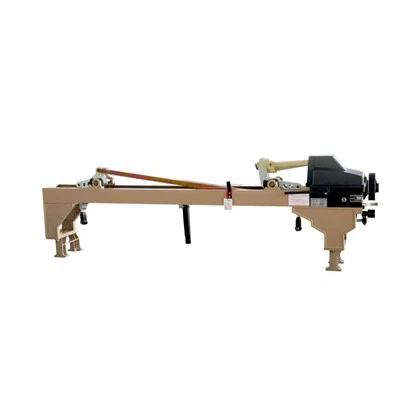

The Fundamental Difference in Power Transmission: A cam-driven loom, like a precise mechanical watch, uses a rotating cam to drive a connecting rod, completing the jacquard motion. Each rotation corresponds to a fixed pattern cycle. A chain-driven loom, on the other hand, is like a bicycle chain drive, where the chain moves the heald frame up and down, and the pattern changes depend on the chain's arrangement. The former is suitable for complex symmetrical patterns, while the latter excels at continuous gradient textures.
Differences in Adaptability to Home Textile Fabrics: A cam-driven loom can maintain a stitch accuracy of 0.1mm when weaving delicate materials such as high-count cotton and silk. When handling heavy curtains or jacquard blankets, the flexible transmission of a chain-driven loom can buffer yarn tension and prevent warp breakage. Tests show that when weaving high-density fabrics of 60S and above, the defect rate of a cam-driven loom is 40% lower than that of a chain-driven loom.
Long-Term Comparison of Maintenance Costs: A cam mechanism requires regular grinding of the cam surface to maintain accuracy and requires professional maintenance every 800 hours. A chain-driven loom only requires regular lubrication, but the entire chain assembly needs to be replaced every 2000 hours. Over a ten-year lifespan, the total maintenance cost of a chain machine is 25-30% lower than that of a cam machine, but the fineness of the pattern will decrease over time.