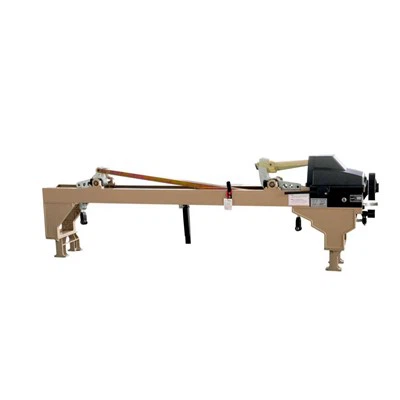

A jacquard loom is a textile machine used to weave fabrics with complex patterns. It controls the raising and lowering of warp threads through pre-programmed settings (such as heddles and pattern books), thus producing beautifully patterned silks. Compared to ordinary looms, jacquard looms can efficiently produce high-end silk fabrics such as brocade and damask with repeating patterns.
Jacquard technology can be traced back to the Shang Dynasty. Jacquard diamond-patterned damask fabrics discovered in tombs at Yin Ruins in Anyang, Henan Province, indicate that primitive jacquard techniques existed in the Shang Dynasty. The Zhou Dynasty further developed multi-colored jacquard brocade, but early techniques relied mainly on hand-picking, resulting in low efficiency. By the Western Han Dynasty, jacquard loom technology had matured. Four bamboo and wooden loom models (circa 1st century BC) unearthed from the Laoguanshan Han Tomb in Tianhui Town, Chengdu, are the earliest known physical examples of jacquard looms. Their multi-heddle structure allows for the weaving of complex patterns, marking the formal application of jacquard looms in large-scale production. The Eastern Han Dynasty scholar Wang Yi's *Fu on the Jacquard Loom* describes its structure, while the *Miscellaneous Records of the Western Capital* records that the wife of Chen Baoguang from Julu (present-day Hebei) used a jacquard loom with "120 foot pedals" to weave exquisitely patterned brocade. During the Cao Wei period, Ma Jun improved the Han Dynasty jacquard loom, simplifying the complex structure requiring 120 foot pedals to 12, and adopting the bundled heddle jacquard method, making operation more convenient and increasing production efficiency by 4-5 times, while also producing more exquisite patterns. The *Gengzhi Tu* by Lou Shou of the Song Dynasty and the *Tiangong Kaiwu* of the Ming Dynasty both record the evolution of the jacquard loom, its basic structure remaining in use until the 18th century.
Further Knowledge:
① The intricately patterned silks woven on jacquard looms became important commodities on the Silk Road, promoting the economic and cultural exchange between East and West, and were even regarded by the West as a representative of "Oriental luxury." ② The jacquard loom was introduced to Europe twice, in the 7th-8th centuries and the 12th century. Its pattern-based programmable control principle inspired the pattern-based jacquard technology of the 18th-century French Jacquard loom, indirectly influencing the binary programming concept of modern computers. ③ The Han Dynasty jacquard loom not only represents the pinnacle of ancient textile technology but also embodies the aesthetics and wisdom of Chinese culture. Artifacts such as the velvet brocade and the bird-patterned brocade unearthed from the Mawangdui Han tombs testify to its exquisite craftsmanship. ④ Some traditional weaving workshops still use improved hand-operated jacquard looms to replicate Han Dynasty patterns, preserving intangible cultural heritage. ⑤ The jacquard loom controls patterns through a "pattern book" (perforated cards or woven cords), considered one of the early "programmed" machines, offering some inspiration for modern computer programming.
In conclusion, the Han Dynasty jacquard loom represents the culmination of ancient Chinese science and art. Its innovative pattern-based programmable control technology not only promoted the prosperity of the silk industry but also laid the foundation for the development of textile machinery worldwide. It was hailed by British scientist Joseph Needham as "one of the major contributions of ancient China to world mechanical engineering." From the primitive embroidery of the Shang Dynasty to the mechanized leap of the Han Dynasty, and then to the modern digital innovation, jacquard technology has always been an epitome of the innovative spirit of Chinese civilization.